
Microsoft explains how lead gave Majorana 2 a 1,000x gain
On 16 November 2026, Microsoft published an eight-minute video explaining how, by its own measurements, its Majorana 2 quantum chip came to hold its state about 1,000 times longer than the chip before it. The company's answer is a change of materials: lead in place of aluminium, and antimony added to the semiconductor underneath. Physicists outside Microsoft still dispute what the measurements prove.
Microsoft announced Majorana 2 on 2 June 2026 at its Build conference in San Francisco, with a preprint signed by 165 authors. It is the company's second chip built on topological qubits, which store quantum information in the parity of a nanowire: whether it holds an even or an odd number of electrons. Majorana 1, the first, was shown in February 2025.
What changed inside the chip
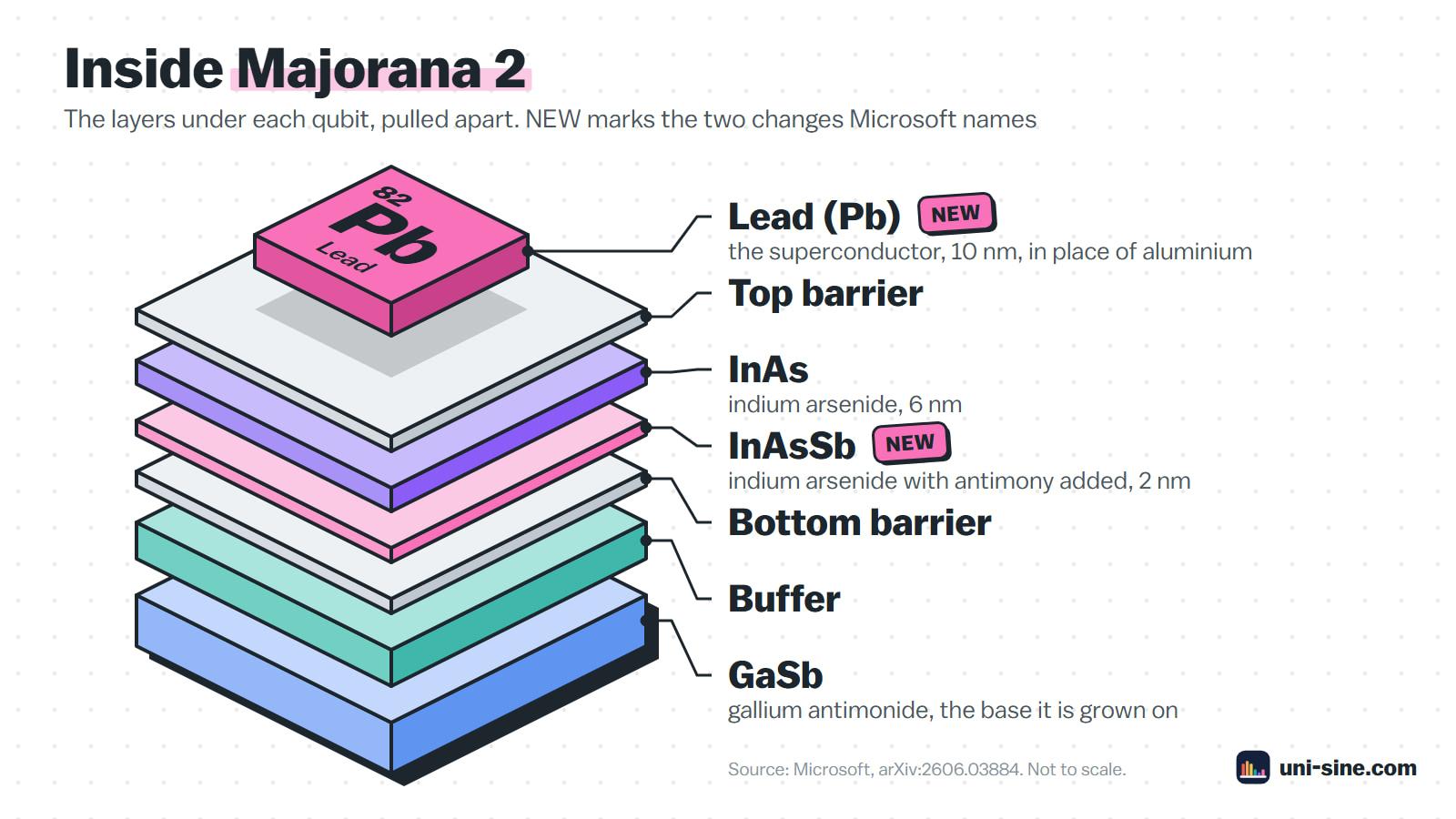
Each qubit sits on a stack of crystal layers grown one on top of another. In Majorana 1 the top layer, the superconductor, was aluminium, over a thin sheet of indium arsenide (InAs) where the electrons move. In Majorana 2 the superconductor is a film of lead 10 nanometres thick. Under it the electrons now move in two layers: 6 nanometres of indium arsenide and 2 nanometres of indium arsenide antimonide (InAsSb), the same crystal with a fifth of its arsenic swapped for antimony. The stack is grown on gallium antimonide (GaSb).
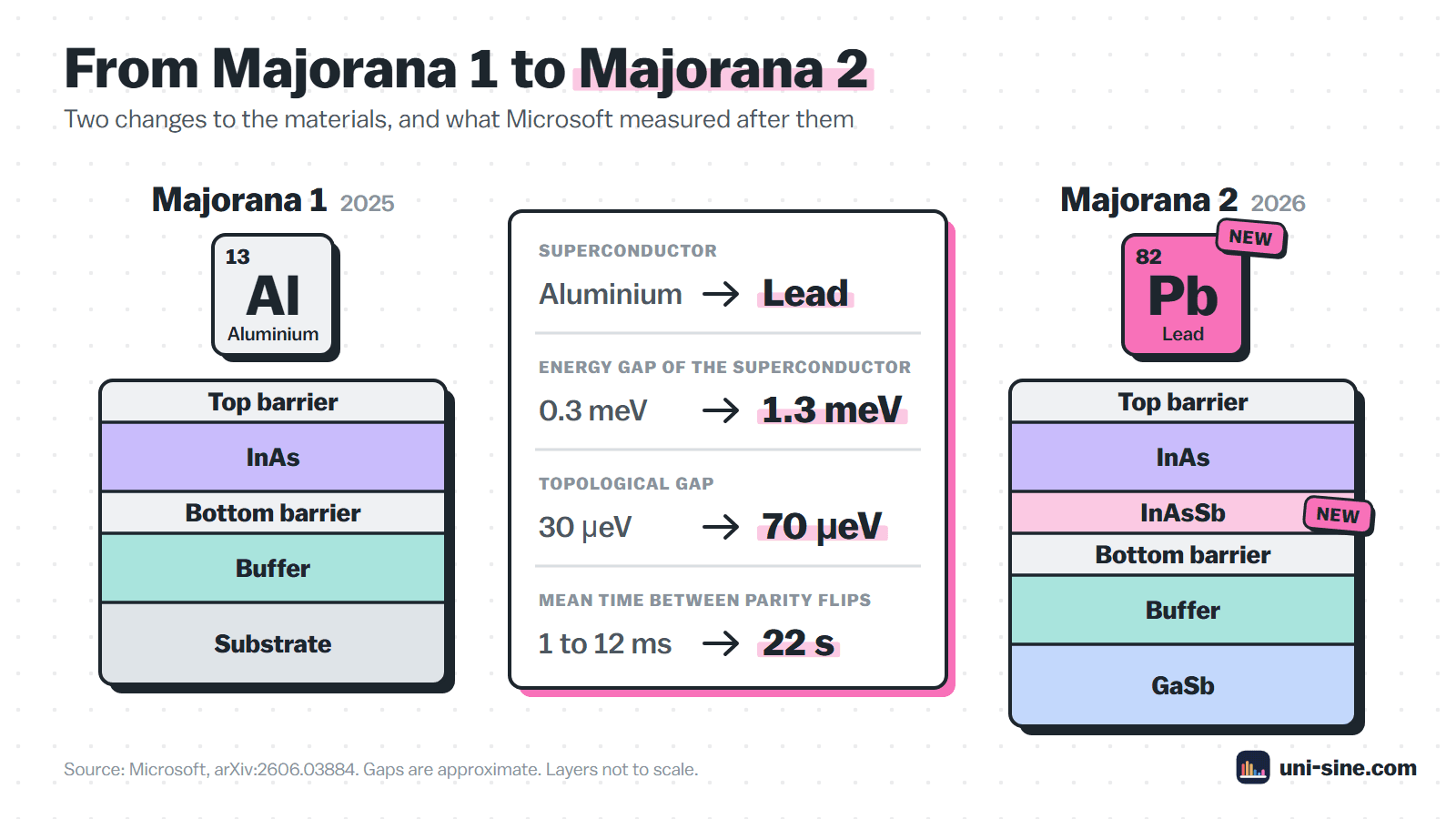
Lead matters because of its energy gap, the energy needed to break up the paired electrons that make a superconductor work. According to the paper, lead's gap is about 1.3 millielectronvolts against about 0.3 for aluminium. The gap that protects the qubit itself, called the topological gap, rose from about 30 to about 70 microelectronvolts by the paper's figures.
What 20 seconds means
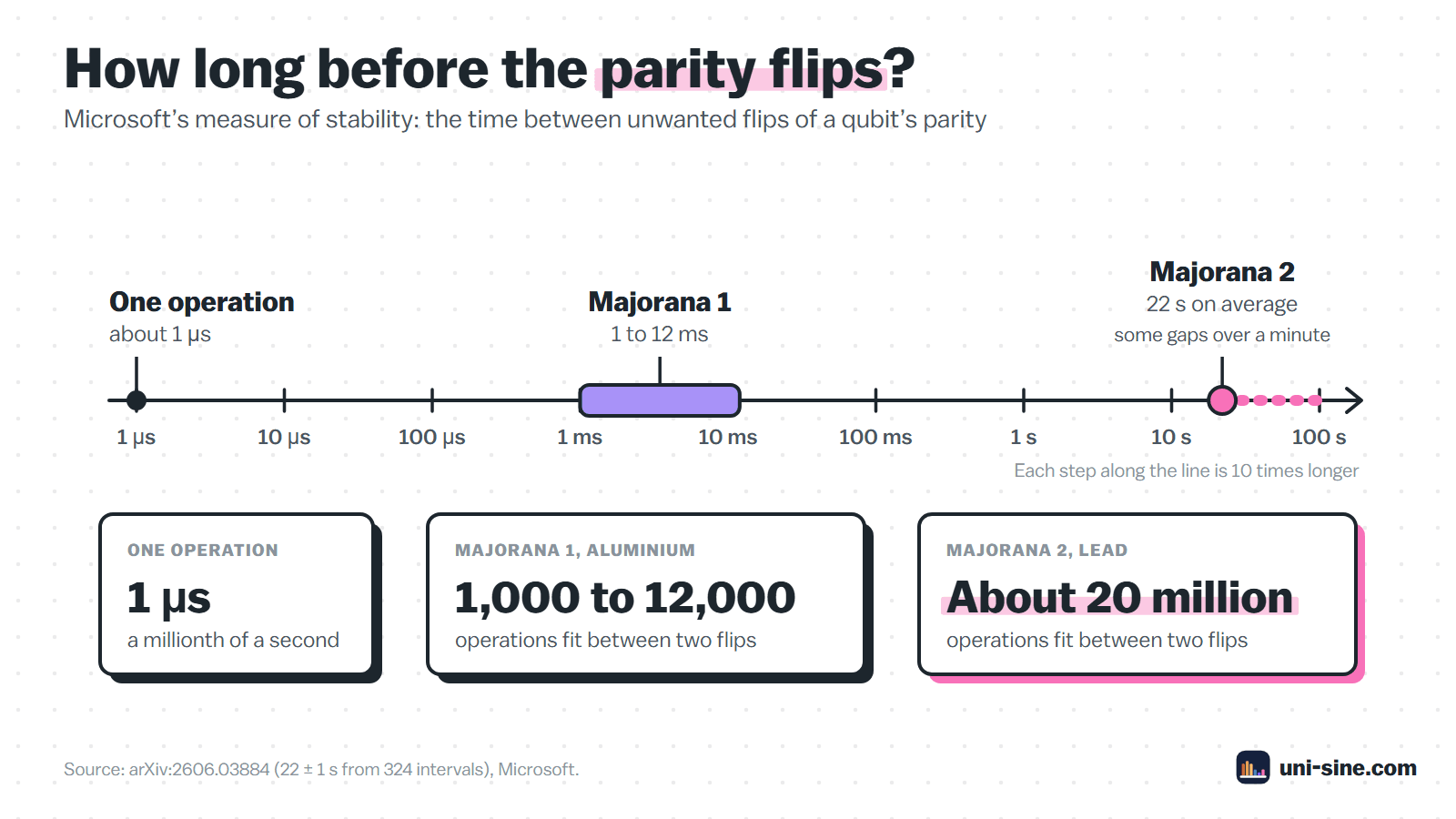
The number Microsoft leads with is the parity lifetime: how long, on average, before the parity flips by accident. The paper puts it at 22 seconds, give or take one, from 324 measured intervals, and says some waits between flips ran to minutes. In the earlier aluminium devices it was 1 to 12 milliseconds. One operation on the chip takes about a microsecond, so about 20 million operations now fit between two flips, where 1,000 to 12,000 did before.
Why two times better gives 1,000 times longer
It wasn't that we made a thousand x improvement in the underlying properties. It was improvements by a multiple of a few, two to three.
The video says the link between the two is exponential. Microsoft has not published a formula for it, but a standard simple model shows how that can happen. If a flip needs a burst of heat large enough to cross an energy gap, the time between flips grows as e to the power of the gap divided by the thermal energy:
At 50 millikelvin, a temperature the paper uses in its own estimates, the thermal energy is about 4.3 microelectronvolts, so a gap of 30 is about 7 times the thermal energy. In the graph, x is how many times bigger the gap becomes and y is how many times longer the wait between flips. A gap 1.5 times bigger gives about 33 times; doubling it gives about 1,000. At the measured 2.3 times, the model gives about 11,000, inside the measured range: 22 seconds is 1,800 to 22,000 times the earlier 1 to 12 milliseconds. This is an illustration, not Microsoft's own calculation.
What physicists dispute
The preprint has not been peer reviewed, and it reports only one of the two kinds of measurement, known as Z and X, that a working qubit needs. Science News reported on 2 June 2026 that physicists were divided. Kartiek Agarwal of Argonne National Laboratory told the magazine the new measurement method was real progress towards showing the states are Majoranas. Henry Legg of the University of St Andrews said the preprint resolves none of the fundamental issues.
Nothing in the presented data proves the existence of a topological qubit or Majoranas in these devices.
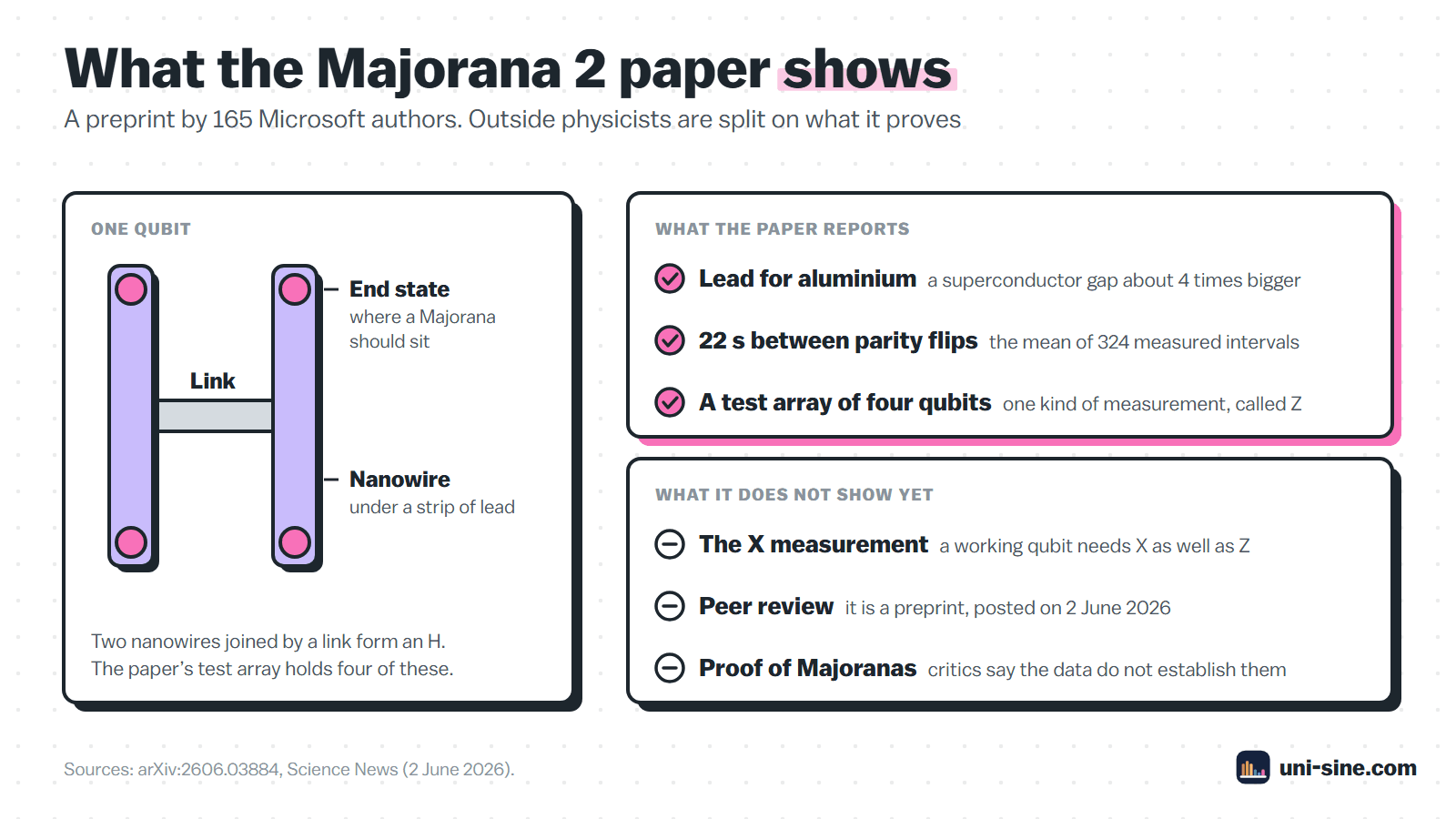
The video answers the doubt directly: scepticism, it says, is a valid and important part of science, and some details are proprietary and cannot be shared.
What happens next
Microsoft says it is now targeting 2029 for quantum computers that solve problems nothing else has solved, half its earlier timeline. The video says Majorana 3, 4 and 5 will follow, and that the challenge now is scaling up. DARPA, the US defence research agency, has named Microsoft one of two companies in the final phase of its programme assessing such machines. On arXiv the paper is still listed without a journal.
Sources
- Microsoft: Majorana 2 Explained: The road to 1000x improvement, 16 November 2026
- Microsoft Quantum blog: Majorana 2, 2 June 2026
- Aghaee et al.: 20 Second Parity Lifetime in an InAs-Pb Tetron Device, arXiv:2606.03884
- Microsoft Source: Majorana 2 and Microsoft Discovery, 2 June 2026
- Science News: Microsoft's quantum chip got an upgrade. Critics are still skeptical, 2 June 2026
- Microsoft Source: Majorana 1, 19 February 2025
 Physics · Atoms and particlesGross committee validates OpenAI Yang-Mills existence proofNobel laureate David Gross chairs the committee that checked an AI-written proof that Yang-Mills theory exists. The mass gap, and the prize, stay open.