
Artemis II: How we successfully went to the moon
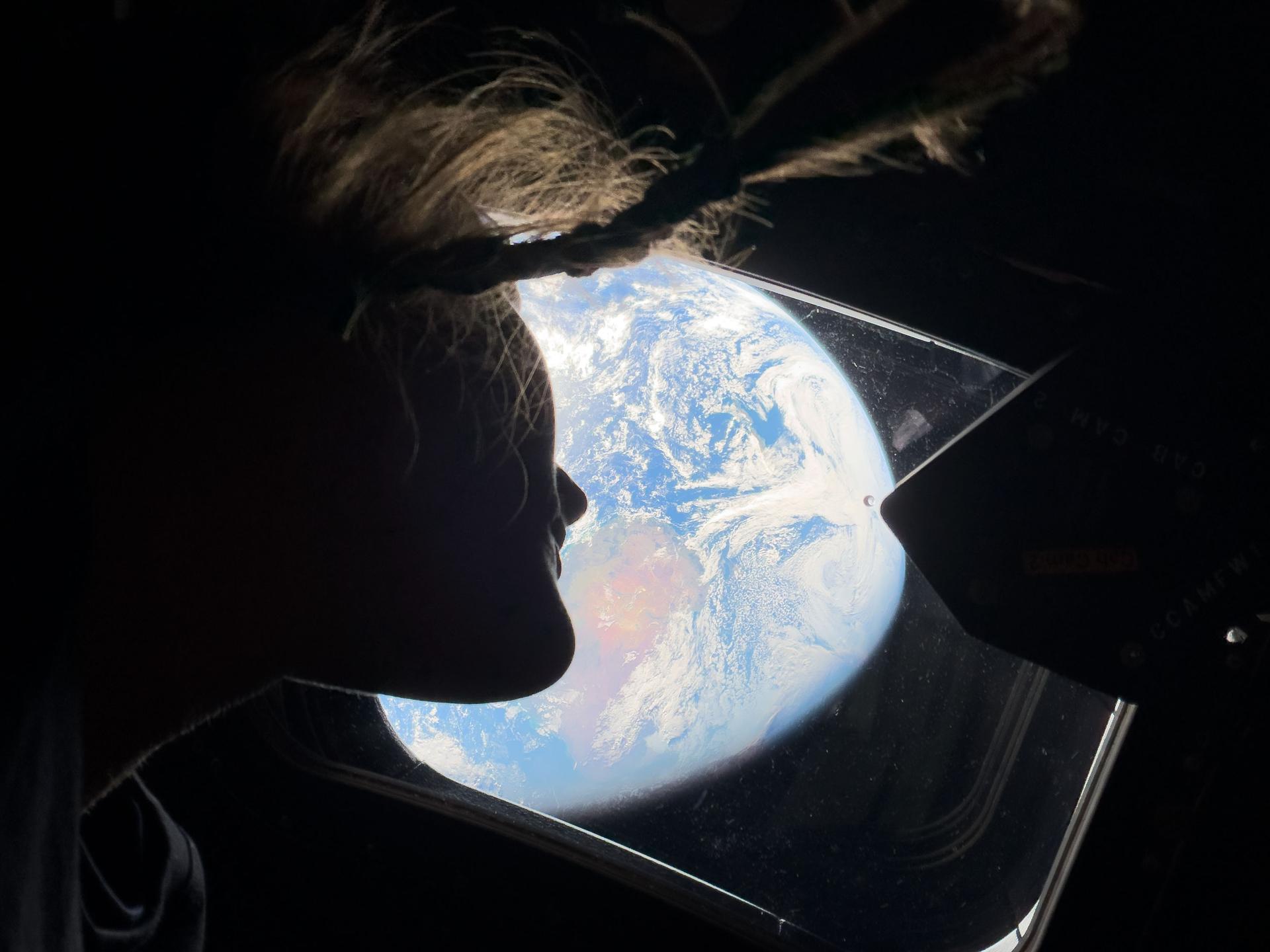
This is the story of how we got back to the Moon. Not landed on it, not yet: Artemis II was a crewed flyby, the first shakedown cruise of a system designed to put humans on the lunar surface later this decade. But it was the hardest part of returning. If the spacecraft, the rocket, and the trajectory all worked with real people on board, the rest of the programme becomes an engineering problem rather than an existential one.
The mission was also the first time in the internet era that millions of people could follow a human lunar trajectory live, with position updates, blurry live downlink video, and the occasional practical reminder that space is mostly about plumbing. We’ll cover that too.
Artemis II trajectory
Trajectory data sourced from NASA
Artemis_II_OEM_2026_04_10_Post-ICPS-Sep-to-EI.asc
The maths behind the loop
A free-return trajectory is a gravitational trick. Aim your spacecraft correctly and the Moon’s gravity bends its path back towards Earth without you firing any engines to come home. The shape is not a simple orbit. It’s a figure-of-eight-like path where most of the work is done by Earth’s gravity and a small correction by the Moon.
The speed profile comes from conservation of energy. Ignoring air drag and thrust, the spacecraft’s kinetic plus gravitational potential energy stays constant, so as it climbs away from Earth (deeper potential, less kinetic) it slows down, then speeds up again on the way back. In symbols:
Plugging in Earth’s GM \approx 3.986 \times 10^{14}\ \text{m}^3/\text{s}^2 and the spacecraft’s starting trans-lunar injection speed of about 10.85\ \text{km/s} at r \approx 6.6 \times 10^6\ \text{m} lets you estimate speed at any distance. By the time Orion swung past the Moon at a closest approach of 4,067\ \text{miles} from the far-side surface, it had slowed to roughly 1\ \text{km/s}. On the way back, gravity converted all that potential energy back into kinetic, and the capsule hit the atmosphere at 24,664\ \text{mph} (about 11\ \text{km/s}).
How long it took
The full mission was 9 days, 1 hour, and 32 minutes from lift-off to splashdown. Break that down and the shape becomes clear:
- Hours after launch: Orion on a high elliptical orbit around Earth. Toilet problems begin. More on that.
- Flight Day 2: trans-lunar injection burn, 5 minutes 49 seconds. After that the rocket is coasting for days.
- Flight Days 3 to 5: the long coast outbound. Nothing dramatic happens, which is exactly what you want.
- Flight Day 6: lunar flyby. Closest approach 4,067 miles from the far-side surface, max distance from Earth 252,756 miles. The Apollo 13 record of 248,655 miles falls.
- Flight Days 7 to 9: coasting home on the free-return trajectory. Mission controllers swap the planned skip re-entry for a direct entry after a heat-shield decision.
- Flight Day 10: splashdown off the coast of San Diego at 5:07 p.m. PDT on 10 April 2026. All four crew walk off the recovery ship.
The effort behind it
Artemis II did not happen because four astronauts were brave. It happened because roughly twenty years of NASA programme management, a $23 billion SLS rocket, an Orion capsule flown uncrewed on Artemis I in late 2022, and the Canadian Space Agency’s contribution of the service module radiators and one mission specialist all had to work together.
The rocket itself is worth a moment. The Space Launch System’s core stage is powered by four upgraded shuttle-era RS-25 engines and two five-segment solid boosters. Lift-off thrust is about 8.8 million pounds, roughly 15 per cent more than the Saturn V. The whole stack is 322 feet tall on the pad.
The crew was Reid Wiseman (commander), Victor Glover (pilot), Christina Koch (mission specialist 1), and Jeremy Hansen (CSA mission specialist 2). Koch had previously flown on the ISS. Hansen became the first Canadian to leave low Earth orbit.
The toilet
No honest account of Artemis II can skip this. Hours after launch, the crew reported that the urine-collection fan on Orion’s Universal Waste Management System had jammed. NASA’s working theory is that oxone beads, which treat the wastewater to prevent biofilm growth, came loose and clogged the fan separator. Christina Koch spent several hours of flight-day-one reset procedures getting it working.
Later in the mission, a separate problem appeared in the vent line that dumps waste to space. Controllers think a chemical reaction with the treatment compounds produced debris that caught in a filter, and some of the water froze in the line. The fix was to rotate the capsule so the sun warmed the frozen section. Backup plan if that failed: collapsible contingency urinals, which are exactly what they sound like.
This matters more than it sounds. If you cannot reliably handle wastewater on a ten-day free-return, you cannot handle it on a months-long Mars transit. Orion’s toilet is a stepping stone to harder problems, and shaking its bugs out on a flyby is cheaper than shaking them out on a lander.
Other incidents worth flagging
Mission controllers spotted a small helium leak in the European-built service module. It was non-critical and the mission continued on its planned profile. There was also a heat-shield discussion: after noticing some anomalous erosion in Artemis I’s heat shield in 2022, engineers had rebuilt the return profile around a skip re-entry. For Artemis II they reverted to a direct entry, partly because the heat shield performed better than the conservative prediction and partly because a single-peak entry is easier on the crew.
The TLI burn itself was slightly long by design to account for dispersions, and the lunar flyby geometry was nudged inward by about 130 miles to buy extra margin on the return.
What this sets up
Artemis II is the last mission before Artemis III, which is the one that actually lands people on the Moon. That mission needs a SpaceX Starship Human Landing System to rendezvous in lunar orbit, a lunar surface EVA suit that can survive the south-pole environment, and a crew trained on equipment that did not exist when this article’s authors were born. Most of that programme’s risk is now landing-specific. The transit risk, which is what Artemis II was there to retire, is retired.
 Physics · SpaceHow old is the universe? 13.8 billion years, explainedThe universe is about 13.8 billion years old. See the three ways scientists measure its age, the Hubble tension, and worked examples you can follow.